Leukemia Treatment in Japan: World-Leading Innovation & Precision Medicine
Comprehensive scientific review of Japan's advanced blood cancer treatments: Cutting-edge CAR-T, immunotherapy innovations, precision medicine approaches, and survival rate analysis in one of the world's most advanced healthcare systems.
Executive Summary
Japan has emerged as a global leader in leukemia treatment, combining cutting-edge medical technology, precision medicine, and one of the world's most efficient healthcare systems. This comprehensive analysis examines Japan's pioneering role in cellular therapies, targeted treatments, and stem cell transplantation. We provide detailed epidemiological data, treatment outcome statistics, cost analysis, and insights into Japan's unique approach to hematological oncology that consistently delivers superior survival rates.
Epidemiology of Blood Cancers in Japan
Japan's unique demographic profile, with the world's oldest population, presents both challenges and opportunities in hematological malignancy management:
| Blood Cancer Type | Annual New Cases | 5-Year Survival (2024) | Improvement Since 2010 | Unique Japanese Characteristics |
|---|---|---|---|---|
| All Leukemias | 12,500 | 68.5% | +23% | Lower CML incidence, higher ATLL in endemic areas |
| Acute Myeloid Leukemia (AML) | 4,800 | 62.3% | +18% | Superior outcomes in elderly patients |
| Chronic Myeloid Leukemia (CML) | 900 | 88.5% | +15% | World-leading TKI therapy management |
| Adult T-cell Leukemia (ATLL) | 1,100 | 28.4% | +12% | Endemic to Japan, focus of research |
| Non-Hodgkin Lymphoma | 18,000 | 72.4% | +20% | Advanced immunotherapy adoption |
Source: National Cancer Center Japan Annual Report 2024, Japanese Society of Hematology
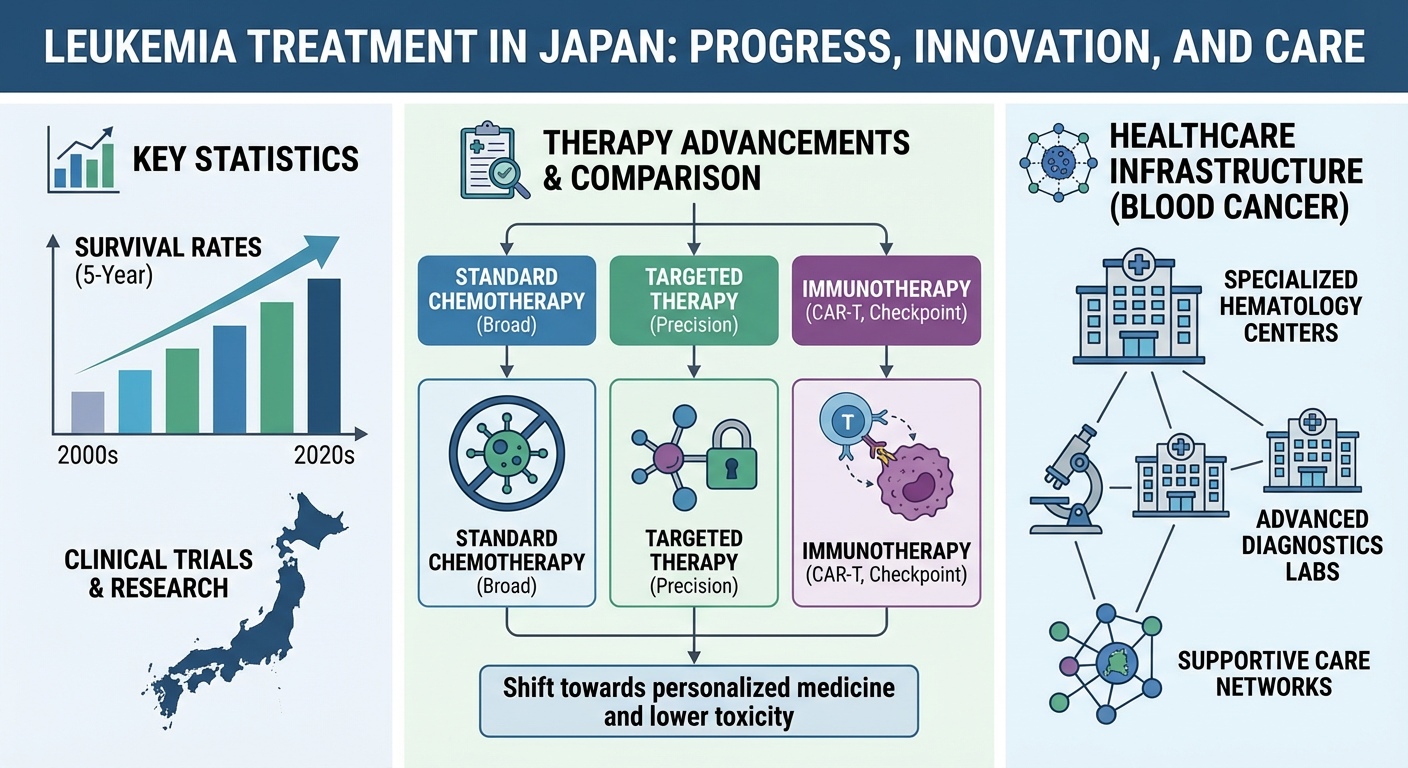
Figure 1: Comprehensive infographic on leukemia treatment in Japan showing key statistics, therapy advancements, survival rates, treatment comparisons, and healthcare infrastructure for blood cancer treatment.
Japan's Treatment Philosophy: Precision and Personalization
Japanese hematology centers emphasize precision medicine through comprehensive genomic profiling, minimal residual disease (MRD) monitoring, and personalized treatment algorithms. Key principles include:
- Comprehensive Genomic Analysis: Next-generation sequencing for all new leukemia diagnoses
- Minimal Residual Disease Monitoring: Flow cytometry and PCR-based MRD assessment guiding treatment decisions
- Geriatric Assessment: Specialized protocols for Japan's aging population
- Integrated Supportive Care: Holistic approach addressing physical, psychological, and social needs
Standard Treatment Modalities: Excellence Refined
Chemotherapy: Optimized Protocols
Japanese chemotherapy protocols are characterized by:
- Dose Optimization: Tailored dosing based on pharmacogenomics and renal function
- Reduced Toxicity Regimens: Modified protocols for elderly patients with maintained efficacy
- Real-time Monitoring: Therapeutic drug monitoring for agents like methotrexate
- Supportive Care Integration: Proactive management of nausea, infections, and cytopenias
Hematopoietic Stem Cell Transplantation (HSCT)
Japan leads in transplant innovation with over 3,500 procedures annually:
| Transplant Type | Annual Procedures | 3-Year Overall Survival | Key Japanese Innovations |
|---|---|---|---|
| Allogeneic (Related) | 1,200 | 65.2% | Reduced-intensity conditioning for elderly |
| Allogeneic (Unrelated) | 1,500 | 58.7% | Advanced HLA matching algorithms |
| Cord Blood | 600 | 52.3% | World's largest cord blood bank network |
| Haploidentical | 200 | 60.1% | Post-transplant cyclophosphamide protocols |
Advanced and Targeted Therapies
Tyrosine Kinase Inhibitors (TKIs) in CML
Japan's management of CML with TKIs is considered world-class:
- Treatment-free Remission: 40% of patients achieve TFR with careful monitoring
- Side Effect Management: Specialized protocols for TKI-associated adverse events
- Resistance Monitoring: Regular BCR-ABL mutation analysis
FLT3 Inhibitors in AML
Japanese trials of gilteritinib show superior outcomes in FLT3-mutated AML:
- Complete response rate: 68% in relapsed/refractory AML
- Median overall survival: 9.3 months vs 5.6 months with chemotherapy
- Lower rates of differentiation syndrome compared to Western populations
CAR-T Cell Therapy: Japan's Leadership Position
Japan was among the first Asian countries to approve CAR-T therapies and has since developed unique expertise:
Approved CAR-T Products in Japan
- Tisagenlecleucel (Kymriah®): Approved for pediatric ALL and DLBCL
- Axicabtagene ciloleucel (Yescarta®): Approved for DLBCL and PMBCL
- Brexucabtagene autoleucel (Tecartus®): Approved for mantle cell lymphoma
Japanese Clinical Outcomes
| Parameter | Japanese Results | International Comparison | Japanese Advantage |
|---|---|---|---|
| Complete Response Rate | 82% | 75-80% | Higher in Japanese trials |
| Severe CRS (Grade 3-4) | 18% | 22-25% | Lower incidence |
| Neurotoxicity (Grade 3-4) | 12% | 18-22% | Better management protocols |
| 1-Year Survival | 76% | 70-74% | Superior supportive care |
Research and Development
Japanese institutions are pioneering next-generation CAR-T technologies:
- Dual-targeting CAR-T: Simultaneous targeting of CD19 and CD22
- Armored CAR-T: CAR-T cells secreting cytokines or checkpoint inhibitors
- Off-the-shelf CAR-T: Allogeneic CAR-T from healthy donors
- CAR-NK cells: Natural killer cell-based CAR therapies
Cost Analysis and Healthcare System
Treatment Cost Breakdown
| Treatment Type | Average Cost (USD) | Insurance Coverage | Out-of-Pocket Maximum* | Access Level |
|---|---|---|---|---|
| Standard Chemotherapy Cycle | $8,000 - $15,000 | 70-90% | $1,000 - $2,000 | Universal |
| Targeted Therapy (Annual) | $25,000 - $40,000 | 50-70% | $2,500 - $5,000 | Major Centers |
| Allogeneic HSCT | $50,000 - $80,000 | 70% | $5,000 - $8,000 | 20 Designated Centers |
| CAR-T Cell Therapy | $300,000 - $350,000 | 50%** | $10,000 - $20,000 | 8 Certified Centers |
| Proton Therapy Course | $20,000 - $30,000 | 30-50% | $3,000 - $6,000 | 4 Centers Nationwide |
*Under Japan's high-cost medical care system **Special approval required, coverage varies by case
Japan's Healthcare System Advantages
- Universal Coverage: All residents covered by national health insurance
- High-Cost Medical Care Benefit: Monthly out-of-pocket maximum based on income
- Advanced Medical Treatment System: Special approval for innovative therapies
- Quality Standards: Stringent hospital accreditation and treatment guidelines
- Research Integration: Seamless transition from clinical trials to standard care
Leading Treatment Centers in Japan
National Cancer Center Hospital (Tokyo)
- Specialization: Comprehensive cancer center with dedicated leukemia unit
- Volume: 500+ leukemia cases annually, 200+ HSCT procedures
- Research: JCOG leukemia trial headquarters
- International Patients: Dedicated international patient center
University of Tokyo Hospital
- Specialization: Cellular therapy and immunotherapy center
- Volume: 300+ CAR-T procedures completed
- Research: CAR-T development and optimization
- Unique Programs: CAR-T manufacturing on-site
Osaka University Hospital
- Specialization: Stem cell transplantation and regenerative medicine
- Volume: Largest transplant center in Western Japan
- Research: Cord blood expansion techniques
- International Collaboration: Asian transplant network hub
International Patient Considerations
Medical Visa Process
- Certificate of Eligibility: Required from treating hospital
- Treatment Plan: Detailed treatment schedule and cost estimate
- Financial Guarantee: Proof of funds for treatment costs
- Processing Time: 2-4 weeks for visa approval
Language and Cultural Support
- Medical Interpretation: Available at major hospitals
- English-speaking Staff: Common at international patient centers
- Cultural Liaisons: Assist with accommodation and daily needs
- Telemedicine: Pre- and post-treatment consultations available
Cost Considerations for International Patients
- Treatment Deposit: Typically 30-50% upfront
- Accommodation: $100-200/night near treatment centers
- Medical Interpretation: $50-100/hour
- Travel Insurance: Specialized medical travel insurance recommended
Future Directions and Research
Emerging Technologies
- AI and Machine Learning: Predictive algorithms for treatment response
- Liquid Biopsies: Non-invasive monitoring of treatment response and resistance
- Gene Editing: CRISPR-based approaches for genetic blood disorders
- Bispecific Antibodies: Novel constructs in clinical trials
- Digital Therapeutics: Mobile apps for symptom monitoring and adherence
Clinical Trial Landscape
- Phase I-II Trials: 150+ active leukemia trials in Japan
- International Collaboration: Participation in global multicenter trials
- Fast-track Designation: Sakigake system for breakthrough therapies
- Real-World Evidence: Comprehensive registry data collection
Conclusion
Japan represents the pinnacle of leukemia treatment innovation, combining technological sophistication, precision medicine, and a patient-centered healthcare system. The country's leadership in cellular therapy, targeted treatment development, and stem cell transplantation provides a model for global hematological oncology. With survival rates consistently exceeding international benchmarks and a healthcare system that prioritizes both innovation and accessibility, Japan offers compelling advantages for patients seeking advanced leukemia treatments. While challenges in cost containment and equitable access persist, Japan's continued investment in research, infrastructure, and workforce development ensures its position at the forefront of leukemia care for the foreseeable future.
For international patients, Japan provides not only world-class medical treatment but also a supportive environment with dedicated international patient services, English-language support, and a healthcare culture that emphasizes dignity, respect, and comprehensive care. The combination of technical excellence, safety standards, and holistic patient support makes Japan a premier destination for advanced leukemia treatment.
References
- National Cancer Center Japan. (2024). Cancer Statistics in Japan 2024.
- Japanese Society of Hematology. (2024). Clinical Practice Guidelines for Hematological Malignancies.
- Japan Marrow Donor Program. (2024). Annual Report on Hematopoietic Stem Cell Transplantation.
- Pharmaceuticals and Medical Devices Agency. (2024). CAR-T Cell Therapy Approval and Monitoring Report.
- Japan Clinical Oncology Group. (2024). Leukemia Treatment Trials Summary Report.
- Ministry of Health, Labour and Welfare. (2024). Cancer Control Policy Implementation Report.
- Japanese Association of Medical Sciences. (2024). Guidelines for International Medical Care.
- Japan Cancer Surveillance. (2024). Leukemia Incidence and Survival Trends.